xuenay: (Default)
I've recently been getting a lot out of the psychotherapy model of Internal Family Systems, as described in this book. I recently wrote a comment on Slate Star Codex describing some of its basics and what I've gotten out of it, and thought that I might as well repost it here:

I recommend this book, though with the note that I often don't need to follow the full process outlined there. Sometimes it's definitely necessary, but what I've found even more commonly useful is something that it discusses at the beginning of the book, which it calls "getting into self".

Here's the basic idea. Suppose that a part of your mind is really angry at someone, and telling a story (which might not be true) about how that person is a horrible person with no redeeming qualities. Internal Family Systems says that there are three modes in which you might react to that part:

First, you may be entirely blended with it (for those familiar, this corresponds to what Acceptance and Commitment Therapy calls cognitive fusion). This means that you are experiencing everything in terms of the story that it is telling, and have forgotten that this is an emotional reaction. So you feel that it's just objectively true that the other person is horrible and with no redeeming qualities.

Or you might be partially blended with it. In this case, you realize that you are experiencing an emotional reaction, and that your thoughts and feelings might not be entirely justified, but you still feel them and might not be able to stop yourself from behaving according to them anyway.

Finally, you might be "in Self", meaning entirely unblended. Here you are still aware of the emotions and thoughts, but your subjective experience is that they're not your emotions, they're someone else's - they're coming from a part of your mind which is experienced as separate from "you". In this mode, you do not feel threatened or overwhelmed by them, and you can maintain a state of open curiosity towards whether or not they are actually true.

My experience is that usually if I have an unpleasant emotion, I will try to do one of two things: either reject it entirely and push it out of my mind, or buy into the story that it's telling and act accordingly. Once I learned the techniques for getting into Self, I got the ability to sort of... just hang out with the emotion, neither believing it to be absolutely true nor needing to show it to be false. And then if I e.g. had feelings of social anxiety, I could keep those feelings around and go into a social situation anyway, making a kind of mental move that I might describe as "yes, it's possible that these people all secretly hate me; I'm going to accept that as a possibility without trying to add any caveats, but also without doing anything else than accepting its possibility".

The consequence has been that this seems to make the parts of my mind with beliefs like "doing this perfectly innocuous thing will make other people upset" actually update their beliefs. I do the thing, the parts with this belief get to hang around and observe what happens, notice that nobody seems upset at me, and then they are somewhat less likely to bring up similar concerns in the future.

In terms of global workspace theory, my model here is that there's a part of the mind that's bringing up a concern that should be taken into account in decision-making. The concern may or may not be justified, so the correct thing to do is to consider its possibility, but not necessarily give it too much weight. Going into Self and letting the message stay in consciousness this way seems to make it available for decision-making, and often the module that's bringing it up is happy to just have its message received and evaluated; you don't have to do anything more than that, if it's just holding it up as a tentative consideration to be evaluated.

The book has a few different techniques that you can use for getting into Self. One that I often use is to try to get a sense of where in my body the emotional sensations are coming from, and then let my mind create a visualization based on those. Once I have a visualization and a physical location of the part, it's easier to experience it as "not me". Another thing that I do is to just make that mental move that I described - "okay, this is a possibility, so I'm just going to test it out". I find it useful to first stay blended with the part for a while, to get a sense of what exactly is the story that it's trying to tell, before unblending and getting into Self.

E.g. a while back I was having a sense of loneliness as I laid down for a nap. I stepped into the part's perspective to experience it for a while, then unblended; now I felt it as a black ice hockey puck levitating around my lower back. I didn't really do anything other than let it be there, and maintained a connection with it. Gradually it started generating a pleasant warmth, and then the visualization transformed into a happy napping cartoon fox, curled up inside a fireball that it was using as its blanket. And then I was no longer feeling lonely.

That said, sometimes a part is not content to just raise a tentative possibility; sometimes it feels like something is an emergency, so you must act right away. Obviously, sometimes you really are in an emergency, so this is justified! But often times it's based on the part having an unrealistic fear, which in the IFS model tends to be a result of some past trauma which it is reliving, not realizing that the circumstances of your life have changed and you're now capable of dealing with it. In that case, you need to do the full process described in the book, where you basically get in proper contact with the part in question and address its concerns. (Actually it's a bit more complicated than this, since the IFS model holds that there are many different kinds of parts that may have relationships with each other - so the "beer-drinking part" may be drinking beer in order to keep the traumatized part numb and safely out of consciousness, so you may actually need to deal with two different parts separately. The book goes into a lot more detail.)

Originally published at Kaj Sotala. You can comment here or there.

 
xuenay: (Default)
 Recently on the CFAR alumni mailing list, someone asked a question about how to develop scientific intuition. In response, Mark Eichenlaub posted an excellent and extensive answer, which was so good that I asked for permission to repost it in public. He graciously gave permission, so I’ve reproduced his message below.

From: Mark Eichenlaub
Date: Tue, Oct 23, 2018 at 9:34 AM
Subject: Re: [CFAR Alumni] Suggestions for developing scientific intuition

Sorry for the length, I recently finished a PhD on this topic. (After I wrote the answer kerspoon linked, I went to grad school to study the topic.) This is specifically about solving physics problems but hopefully speaks to intuition a bit more broadly in places.

I mostly think of intuition as the ability to quickly coordinate a large number of small heuristics. We know lots of small facts and patterns, and intuition is about matching the relevant ones onto the current situation. The little heuristics are often pretty local and small in scope.

For example, the other day I heard this physics problem:

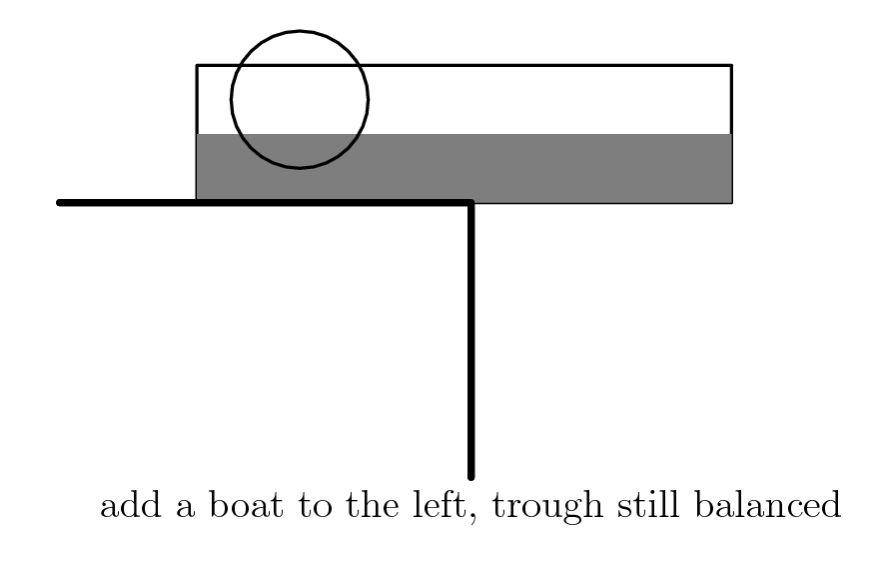
You set up a trough with water in it. You hang just barely less than half of the trough off the edge of a table, so that it balances, but even a small force at the far end would make it tip over.

You put a boat in the trough at the end over the table. The trough remains balanced.

Then you slowly push the boat down to the other end of the trough, so that’s it’s in the part of the trough that hangs out from the table. What happens? (I.E. does the trough tip over?)

The answer is (rot13) Gur gebhtu qbrf abg gvc; vg erznvaf onynaprq (nf ybat nf gur zbirzrag bs gur obng vf fhssvpvragyl fybj fb gung rirelguvat erznvaf va rdhvyvoevhz).

I knew this “intuitively”, by which I mean I got it within a second or so of understanding the question, and without putting in conscious effort to thinking about it. (I wasn’t certain I was right until I had consciously thought it out, but I was reasonably confident within a second, and my intuition bore out.) I don’t think this was due to some sort of general intuition about problem solving, science, physics, mechanics, or even floating. It felt like I could solve the problem intuitively specifically because I had seen sufficiently-similar things that led me to the specific heuristic “a floating object spreads its weight out evenly over the bottom of the container it’s floating in.” Then I think of “having intuition” in physics as having maybe a thousand little rules like that and knowing when to call on which one.

For this particular heuristic, there is a classic problem asking what happens to the water level in a lake if you are in a boat with a rock, and you throw the rock into the water and it sinks to the bottom. One solution to that problem is that when the rock is on the bottom of the lake, it exerts more force on that part of the bottom of the lake than is exerted at other places. By contrast, when the rock is still in the boat, the only thing touching the bottom of the lake is water, and the water pressure is the same everywhere, so the weight of the rock is distributed evenly across the entire lake. The total force on the bottom of the lake doesn’t change between the two scenarios (because gravity pulls on everything just as hard either way), when the rock is sitting on the bottom of the lake and the force on the bottom of the lake is higher under the rock, it must be lower everywhere else to compensate. The pressure everywhere else is $\rho g h$, so if that goes down, the level of the lake goes down. Conclusion: when you throw the rock overboard, the level of the lake goes down a bit. When I thought about that problem, I presumably built the “weight distributed evenly” heuristic. All I had to do was quickly apply it to the trough problem to solve that one as well.

And if someone else also had a background in physics but didn’t find the trough problem easy, it’s probably because they simply hadn’t happened to think about the boat problem, or some other similar problems, in the right way, and hadn’t come away with the heuristic about the weight of floating things being spread out evenly.

To me, this picture of intuition as small heuristics doesn’t look good for the idea of developing powerful intuition. The “weight gets spread out by floating” heuristic is not likely to transfer to much else. I’ve used it for two physics problems about floating things and, as far as I know, nothing else.

You can probably think of lots of similar heuristics. For example, “conservation of expected evidence“. You might catch a mistake in someone’s reasoning, or an error in a long probability calculation you made, if you happen to notice that the argument or calculation violates conservation of expected evidence. The nice thing about this is that it can happen almost automatically. You don’t have to stop after every calculation or argument and think, “does this break conservation of expected evidence?”. Instead, you wind up learning some sorts of triggers that you associate with the principle that prime it in your mind, and then, if it becomes relevant to the argument, you notice that and cite the principle.

In this picture, building intuition is about learning a large number of these heuristics, along with their triggers.

However, while the individual small heuristics are often the easiest things to point to in an intuitive solution to a problem, I do think there are more general, and therefore more transferrable parts of intuition as well. I imagine that the paragraph I wrote explaining the solution to the boat problem will be largely incomprehensible to someone who hasn’t studied physics. That’s partially because it uses concepts they won’t have a rigorous understanding of (e.g. pressure), that it tacitly uses small heuristics it didn’t explain (e.g. that the reason the pressure is the same along the bottom of the lake is that if it weren’t, there would be horizontal forces that push the water around until the pressure did equalize in this way), partially that it made simplifications that it didn’t state and it might not be clear are justified (e.g. that the bottom of the lake is flat). More importantly, it relies on a general framework of Newtonian mechanics. For example, there are a number of tacit applications of Newton’s laws in the argument. For example, I stated that the total force on the bottom of the lake is the same whether the rock is resting on the bottom or floating in the boat “because gravity pulls on everything just as hard either way”, but these aren’t directly connected concepts. Gravity pulls the system (boat + water + rock) down just as hard no matter where the rock is. That system is not accelerating, so by Newton’s second law, the bottom of the lake pushes up on that system just as hard in each scenario. And by Newton’s third law, the system pushes down on the bottom of the lake just as hard in each scenario. So understanding the argument involves some fairly general heuristics such as “apply Newton’s second law to an object in equilibrium to show that two forces on it have equal magnitude” – a heuristic I’ve used hundreds of times, and “decide what objects to define as part of a system fluidly as you go through a problem” (in this case, switching from thinking about the rock as a system to thinking about rock+boat+water as a single system) – a skill I’ve used hundreds to thousands of times across all of physics. (My job is to teach high schoolers to be really good at solving problems like this, so I spend way more time on it than most people, so applying a heuristic specific to solving introductory physics problems in a thousand independent instances is realistic for me.)

Then there may be more meta-level skills and heuristics that you develop in solving problems. These could be things like valuing non-calculation solutions, or believing that persevering on a tough problem is worthwhile. It’s also important that intuition isn’t just about having lots of little heuristics. It’s about organizing them and calling the right one up at the right time. You’ll have to ask yourself the right sorts of questions to prompt yourself to find the right heuristics, and that’s probably a pretty general skill.

There is a fair amount of research on trying to understand what all these little heuristics are and how to develop them, but I’m mostly familiar with the research in physics.

In the Quora answer kerspoon linked, I cited George Lakoff, and I still that he’s a good source for understanding how we go about taking primitive sorts of concepts (e.g. “up” and “down”) and using and adapting them, via partial metaphor, to understanding more abstract things. For a specific example that’s well-argued, see:

Wittmann, Michael C., and Katrina E. Black. “Mathematical actions as procedural resources: An example from the separation of variables.” Physical Review Special Topics-Physics Education Research 11.2 (2015): 020114.

They argue that students understand the arithmetic action “separation of variables” via analogy to their physical understanding of taking things and physically moving them around. However, I think Wittman and Black’s work is incomplete. For example, it doesn’t explain why students using the motion analogy for separation of variables do it correctly – they could just as well use motion to encode algebraically-invalid rules. Also, they don’t explain how the analogy develops. They just catalog that it exists.

A foundational work in trying to understand the components of physical intuition is:

DiSessa, Andrea A. “Toward an epistemology of physics.” Cognition and instruction 10.2-3 (1993): 105-225.

This work establishes “phenomenological primitives”; little core heuristics such as “near is more”, which are templates for physical reasoning. Drawing from these templates, we might conclude that the nearer you are to a speaker, the louder the sound, or that the nearer you are to the sun, the hotter it will be (and therefore that summer is hot because the Earth is nearer the sun – a false but common and reasonable belief).

That’s a long and somewhat-obscure paper. I really like his student’s work

Sherin, Bruce L. “How students understand physics equations.” Cognition and instruction 19.4 (2001): 479-541.

Like Disessa, Sherin builds his own framework for what intuition is. His scope is more limited though, focusing solely on building and interpreting certain types of equations in a manner that combines “intuitive” physical ideas and mathematical templates. He spells this out in detail more in the paper, and it’s incredibly clear and well-argued. Probably my favorite paper in the field.

A more general reference that’s much more accessible than Disessa and more general an overview of cognition in physics than Sherin is
“How Should We Think About How Our Students Think” by my advisor, Joe Redish http://media.physics.harvard.edu/video/?id=COLLOQ_REDISH_093013 (video) https://arxiv.org/abs/1308.3911 (paper).

The actual process of building new heuristics is also studied, but over all I don’t think we know all that much. See my friend Ben’s paper

Dreyfus, Benjamin W., Ayush Gupta, and Edward F. Redish. “Applying conceptual blending to model coordinated use of multiple ontological metaphors.” International Journal of Science Education 37.5-6 (2015): 812-838.

for an example of theory-building around how we create new intuitions. He calls on a framework from cognitive science called “conceptual blending” that is rather formal, but I think pretty entertaining to read.

A relevant search terms in the education literature:

“conceptual change”

but I find a lot of this literature to be hard-to-follow and not always a productive use of time to read.

On the applied side, I think the state of the art in evidence-backed approaches to building intuition, at least in physics, is modeling instruction. I’m not sure what the best introduction to modeling instruction is. They have a website that seems okay. Eric Brewe writes on it and he’s usually very good. The basic idea is to have students collaboratively participate in the building of the theories of physics they’re using (in a specific way, with guidance and direction from a trained instructor), which gets them to think about the “whys” involved with a particular theory or model in a way they usually wouldn’t.

I have written some about why I think things like checking the extreme cases of a formula are powerful intuition-building tools. A preprint is available here: https://arxiv.org/pdf/1804.01639.pdf

However, I think it’s dangerous to have rules like “always check the dimensions of your answer”, “always check the extreme cases of a formula”, or even “always check that the numbers come out reasonable.” The reason is that having these things as procedures tends to encourage students to follow them by rote. A large part of the cognitive work involved isn’t in checking the extreme cases or the dimensions, but in realizing that in this particular situation, that would be a good thing to do. If you’re doing it only because an external prompt is telling you to, you aren’t building the appropriate meta-level habits. See https://www.tandfonline.com/doi/abs/10.1080/09500693.2017.1308037 for an example of this effect.

See papers on “metarepresentation” by Disessa and/or Sherin for another example of generalizable skills related to intuition and problem solving.

Unfortunately, I don’t think writing books well or writing courses of individual study is something we know much about. I don’t know anyone who has a significant grant for that; the most I’ve ever seen on it is a poster here or there at a conference. Generally, grants are awarded for improving high school and college courses, or for professional development programs, supporting department or institution level changes at schools, etc. So adults who just want to learn on their own are not really served much by the research on the area. If you’re an adult who wants to self-study theoretical physics with an eye towards intuition, I recommend Leonard Susskind’s series of courses “The Theoretical Minimum” (the first three courses exist as books, the rest only as video lectures). He approaches mathematical topics with what I find an intuitive approach in most cases. Of course the Feynman lectures on physics are also very good.

I’ll be building an introduction to physics course at Art of Problem Solving, starting work sometime this winter. It might be available in the spring, although students will mostly be middle and high school students (but anyone is welcome to take our courses). I currently teach an advanced physics problem-solving course at AoPS called “PhysicsWOOT”. I try to support intuition-building practices there, but the main aim is in training these many small heuristics which students need to solve contest problems.

There should be something like modeling instruction for adult independent learners, but I don’t know of it.

Originally published at Kaj Sotala. You can comment here or there.

xuenay: (Default)
There’s a common narrative about confidence that says that confidence is good, insecurity is bad. It’s better to develop your confidence than to be insecure. There’s an obvious truth to this.

But what that narrative does not acknowledge, and what both a person struggling with insecurity and their well-meaning friends might miss, is that that insecurity may be in place for a reason.

You might not notice it online, but I’ve usually been pretty timid and insecure in real life. But this wasn’t always the case. There were occasions earlier in my life when I was less insecure, more confident in myself.

I was also pretty horrible at things like reading social nuance and figuring out when and why someone might be offended. So I was given, repeatedly, the feedback that my behavior was bad and inappropriate.

Eventually a part of me internalized that as “I’m very likely to accidentally offend the people around me, so I should be very cautious about what I say, ideally saying nothing at all”.

This was, I think, the correct lesson to internalize at that point! It shifted me more into an observer mode, allowing me to just watch social situations and learn more about their dynamics that way. I still don’t think that I’m great at reading social nuance, but I’m at least better at it than I used to be.

And there have been times since then when I’ve decided that I should act with more confidence, and just get rid of the part that generates the insecurity. I’ve been about to do something, felt a sense of insecurity, and walked over the feeling and done the thing anyway.

Sometimes this has had good results. But often it has also led to things blowing up in my face, with me inadvertently hurting someone and leaving me feeling guilty for months afterwards.

Turns out, that feeling of insecurity wasn’t a purely bad thing. It was throwing up important alarms which I chose to ignore, alarms which were sounding because it recognized my behavior as matching previous behavior which had had poor consequences.

Yes, on many occasions that part of me makes me way too cautious. And it would be good to moderate that caution a little. But the same part which generates the feelings of insecurity is the same part which is constantly working to model other people and their experience, their reactions to me. The part that is doing its hardest to make other people feel safe and comfortable around me, to avoid doing things that would make them feel needlessly hurt or upset or unsafe, and to actively let them know that I’m doing this.

Just carving out that part would be a mistake. A moral wrong, even.

The answer is not to get rid of it. The answer is to integrate its cautions better, to keep it with me as a trusted friend and ally – one which feels safe enough about getting its warnings listened to, that it will not scream all the time just to be heard.

Originally published at Kaj Sotala. You can comment here or there.

xuenay: (Default)
 Long-Term Trajectories of Human Civilization (free PDF). Foresight, forthcoming, DOI 10.1108/FS-04-2018-0037.

Authors: Seth D. Baum, Stuart Armstrong, Timoteus Ekenstedt, Olle Häggström, Robin Hanson, Karin Kuhlemann, Matthijs M. Maas, James D. Miller, Markus Salmela, Anders Sandberg, Kaj Sotala, Phil Torres, Alexey Turchin, and Roman V. Yampolskiy.

Abstract
Purpose: This paper formalizes long-term trajectories of human civilization as a scientific and ethical field of study. The long-term trajectory of human civilization can be defined as the path that human civilization takes during the entire future time period in which human civilization could continue to exist.
Approach: We focus on four types of trajectories: status quo trajectories, in which human civilization persists in a state broadly similar to its current state into the distant future; catastrophe trajectories, in which one or more events cause significant harm to human civilization; technological transformation trajectories, in which radical technological breakthroughs put human civilization on a fundamentally different course; and astronomical trajectories, in which human civilization expands beyond its home planet and into the accessible portions of the cosmos.
Findings: Status quo trajectories appear unlikely to persist into the distant future, especially in light of long-term astronomical processes. Several catastrophe, technological transformation, and astronomical trajectories appear possible.
Value: Some current actions may be able to affect the long-term trajectory. Whether these actions should be pursued depends on a mix of empirical and ethical factors. For some ethical frameworks, these actions may be especially important to pursue.

An excerpt from the press release over at the Global Catastrophic Risk Institute:

Society today needs greater attention to the long-term fate of human civilization. Important present-day decisions can affect what happens millions, billions, or trillions of years into the future. The long-term effects may be the most important factor for present-day decisions and must be taken into account. An international group of 14 scholars calls for the dedicated study of “long-term trajectories of human civilization” in order to understand long-term outcomes and inform decision-making. This new approach is presented in the academic journal Foresight, where the scholars have made an initial evaluation of potential long-term trajectories and their present-day societal importance.

“Human civilization could end up going in radically different directions, for better or for worse. What we do today could affect the outcome. It is vital that we understand possible long-term trajectories and set policy accordingly. The stakes are quite literally astronomical,” says lead author Dr. Seth Baum, Executive Director of the Global Catastrophic Risk Institute, a non-profit think tank in the US.

The group of scholars including Olle Häggström, Robin Hanson, Karin Kuhlemann, Anders Sandberg, and Roman Yampolskiy have identified four types of long-term trajectories: status quo trajectories, in which civilization stays about the same, catastrophe trajectories, in which civilization collapses, technological transformation trajectories, in which radical technology fundamentally changes civilization, and astronomical trajectories, in which civilization expands beyond our home planet.

Available here: http://gcrinstitute.org/papers/trajectories.pdf

Originally published at Kaj Sotala. You can comment here or there.
xuenay: (Default)
I haven't really been to museums as an adult; not because I'd have been particularly Anti-Museum, but just because museums never happened to become a Thing That I Do. I vaguely recall having been to a few museums with my parents when I was little, an occasional Japan exhibition as a teen when Japan was a Thing, and a few visits to various museums with school. I think my overall recollection of those visits afterwards could be summarized as being around 5.5 on the BoardGameGeek rating scale grade of "5/10: Slightly boring, take it or leave it" and "6/10: Ok - will play if in the mood". (The BGG rating scale is my favorite of the ones that I've seen, but I digress.) 

So I'm not sure, but it's at least possible that between becoming an adult and yesterday, I didn't visit a single museum.

For the last year or so however, I've had a definite feeling of being stuck in a rut, life-wise. Up until summer last year, I used to have a lot of anxiety; I'm still not totally free of it, but I've reduced the amount of it enough that escaping from it is no longer my main driving motivation, the way that it used to be. Meaning that I'm more free to focus on things that I actually enjoy.

But once you have spent most of your adult life feeling a desperate need to escape from a constant level of background anxiety, anxiety which was preventing you from doing anything slow-paced as that would have been insufficient to drown out the suffering... then it's hard to know *what* you really enjoy anymore. Because you haven't really been looking for enjoyable things, you have been looking for things that would make the pain go away. 

What I was left with, even after getting rid of most of the anxiety, was some level of anhedonia - a difficulty deriving any pleasure from something. And most of my old routines were built around doing things that were mainly palliatives for anxiety, rather than being particularly enjoyable.

Then one day, I happened to see a news article saying something about how the national Museum Card - a single card that you can buy for a year, that gives you free access to various museums around the country - had brought more visitors to museums. And it crossed my mind that visiting museums is a Thing That People Do, which I wasn't doing, and that I probably hadn't been able to properly appreciate museums as a kid.

Also, that it would be a fun adventure to go around the country and visit all the various museums that the card gives you access to (currently 278 of them). That kind of an adventure was also Something That People Did, but which hadn't really been the Kind Of Thing That I Would Do.

So I happened to mention this idea in a conversation with my good friend Tiina, who then mentioned that she also had a museum card, and that company would be welcome. That wasn't quite an agreement to visit *all* the museums in the country, but still good enough to get started!

Our first visit, today, was to Tampere Art Museum. I had no particular reason for picking this place in particular: me and Tiina would be traveling elsewhere later in the day, so I let her as a Tampere local choose a place from which we could easily get to the bus station afterwards. I also found the notion of starting out with an art museum intriguing. Some of the other museums in Tampere, such as the Espionage Museum, Game Museum or Lenin Museum had topics that were intrinsically interesting. But just a generic "art museum" was probably closest to my inner stereotype of the kind of a dull museum that I wasn't really able to appreciate as a kid. This time, I was determined to have an open mind and enjoy my experience, whatever it might be. 

And I did. 

The museum had two exhibitions. The first, Tuomo Rosenlund and Mika Hannu's "Paikan muisti" ("The Memory of Place") consisted of black-and-white drawings of different places in the city of Tampere, together with poems and writing about the history of those places.

I feel like I have recently done a number of things to help me connect with more intuitive parts of my mind, ranging from various psychotherapy-style practices like Focusing, to shaman drumming and mild vision trances. Looking at the various drawings, the thought came to me to let my subconscious complete them. I asked it to do so and it obliged, and in my mind's eye, the black-and-white drawings were flooded with color and texture and depth, and I could experience myself standing in the depicted places, imagining myself into locations that I had never seen before. Not as vividly as actually being there, but as strongly as in a particularly vivid memory. 

That felt enjoyable, like a pleasant meditation exercise. 

And then there was the exhibition by J.A. Juvani, a visual artist who - as I learned - is the national Young Artist of the Year. 

The essence of his pieces, as I experienced them, was that of pure, raw, unashamed sexuality; lust and desire shaded in colors of queer and kink. Furthermore, it was an obviously personal essence; an expression of the artist's own sexuality, an expression of intimacy that drew you in, erotic even to someone like me who doesn't ordinarily think of himself as being physically attracted to men. 

One of his displays was a looping video, on a large screen right in front of the stairs leading to the second floor, placed so that you couldn't avoid seeing it when you came up. At the end of the very suggestive video, he would be staring you right in the eyes; and as I stared back, I felt my breathing growing deeper and faster, as if he was propositioning to me in the flesh right there, me finding him too appealing to say no to. 

What probably got me was the rawness - this was not the nice, unreal kind of erotica where everything is pink and nobody's position ever feels uncomfortable, but the kind of primal lust that felt real and totally uninterested in Photoshopping any aspect of the experience. It was much more interested in just having a good, visceral, _physical_ fuck right then and there.

And it brought up partially forgotten memories. Memories of a same kind of pure, two-sided lust between people, with a force that I realized I probably hadn't experienced since my teen years, in that roller-coaster relationship with my first girlfriend that was all shades of dysfunctional but never lacking in intensity. 

There was a book on Juvani's work on sale; I skimmed it, and his descriptions of his life, the casual sex, the friend who had visited "for a tea and a blowjob" further brought back memories of those first teenage sex experiences, when everything was novel and exciting and innocent and powerful; before I had accumulated the sexual traumas and problems that sometimes make me almost averse over the thought of having sex, even with a willing and desirable partner. 

And there was a sense of catharsis, feeling somehow more *pure* as a result; the same kind of feeling that I may get from writing something that I've managed to really immerse myself in, or from really intensive fiction. A feeling of having connected with deeper, more emotional parts of my mind, and becoming more whole as a result.

It was a good experience. I'm glad that I went.
xuenay: (Default)
 There’s a specific subskill of meditation that I call “not getting swept away by the content”, that I think is generally valuable.

It goes like this. You sit down to meditate and focus on your breath or whatever, and then a worrying thought comes to your mind. And it’s a real worry, something important. And you are tempted to start thinking about it and pondering it and getting totally distracted from your meditation… because this is something that you should probably be thinking about, at some point.

So there’s a mental motion that you make, where you note that you are getting distracted by the content of a thought. The worry, even if valid, is content. If you start thinking about whether you should be engaging with the worry, those thoughts are also content.

And you are meditating, meaning that this is the time when you shouldn’t be focusing on content. Anything that is content, you dismiss, without examining what that content is.

So you dismiss the worry. It was real and important, but it was content, so you are not going to think about it now.

You feel happy about having dismissed the content, and you start thinking about how good of a meditator you are, and… realize that this, too, is a thought that you are getting distracted by.

So you dismiss that thought, too. Doesn’t matter what the content of the thought is, now is not the time.

And then you keep letting go of thoughts that came to your mind, but that doesn’t seem to do anything and you start to wonder whether you are doing this meditation thing right… and aha, that’s content too. So you dismiss that…

The thing that is going on here is that usually, when you experience a distracting thought and want to get rid of it, you often start engaging in an evaluation process of whether that thought should be dismissed or not. By doing so, you may end up engaging with the thought’s own internal logic – which might be totally wrong for the situation.

Yes, maybe your relationship is in tatters and your partner is about to leave you. And maybe there are things that you can do to avoid that fate. Or maybe there are not. But if you try to dismiss the thought by disputing the truth or importance of those things, you will fail. Because they are true and important.

The way to short-circuit that is to move the evaluation a meta-level up and just decide that whatever is content, gets dismissed on that basis. Doesn’t matter if it’s true. It’s content, so not what you are doing now. You avoid getting entangled up with the thought’s internal logic, because you never engage with the internal logic in the first place.

Having this mental motion available to you is also useful outside meditation, if you are prone to having any other thoughts that aren’t actually useful.

As I write this, I’m sitting at a food place, eating the food and watching the traffic outside. And, like I often am, I am bothered by pessimistic thoughts about the future of humanity, and all the different disasters that could befall the world.

Yeah, I could live to see the day when AIs destroy the world, or worse.

That’s true.

That’s also content. I’m not going to engage with that content right now.

Hmm.

I look outside the window, watching cars pass by, and finish my dinner.

The food is tasty.

Originally published at Kaj Sotala. You can comment here or there.

xuenay: (Default)
 I had three new papers either published or accepted into publication last year; all of them are now available online:

  • How Feasible is the Rapid Development of Artificial Superintelligence? Physica Scripta 92 (11), 113001.
    • Abstract: What kinds of fundamental limits are there in how capable artificial intelligence (AI) systems might become? Two questions in particular are of interest: 1) How much more capable could AI become relative to humans, and 2) how easily could superhuman capability be acquired? To answer these questions, we will consider the literature on human expertise and intelligence, discuss its relevance for AI, and consider how AI could improve on humans in two major aspects of thought and expertise, namely simulation and pattern recognition. We find that although there are very real limits to prediction, it seems like AI could still substantially improve on human intelligence.
    • Links: published version (paywalled)free preprint.
  • Disjunctive Scenarios of Catastrophic AI Risk. AI Safety and Security (Roman Yampolskiy, ed.), CRC Press. Forthcoming.
    • Abstract: ​ Artificial intelligence (AI) safety work requires an understanding of what could cause AI to become unsafe. This chapter seeks to provide a broad look at the various ways in which the development of AI sophisticated enough to have general intelligence could lead to it becoming powerful enough to cause a catastrophe. In particular, the present chapter seeks to focus on the way that various risks are disjunctive—on how there are multiple different ways by which things could go wrong, any one of which could lead to disaster. We cover different levels of a strategic advantage an AI might acquire, alternatives for the point where an AI might decide to turn against humanity, different routes by which an AI might become dangerously capable, ways by which the AI might acquire autonomy, and scenarios with varying number of AIs. Whereas previous work has focused on risks specifically only from superintelligent AI, this chapter also discusses crucial capabilities that could lead to catastrophic risk and which could emerge anywhere on the path from near-term “narrow AI” to full-blown superintelligence.
    • Links: free preprint.
  • Superintelligence as a Cause or Cure for Risks of Astronomical Suffering. Informatica 41 (4).
    • (with Lukas Gloor)
    • Abstract: Discussions about the possible consequences of creating superintelligence have included the possibility of existential risk , often understood mainly as the risk of human extinction. We argue that suffering risks (s-risks) , where an adverse outcome would bring about severe suffering on an astronomical scale, are risks of a comparable severity and probability as risks of extinction. Preventing them is the common interest of many different value systems. Furthermore, we argue that in the same way as superintelligent AI both contributes to existential risk but can also help prevent it, superintelligent AI can both be a suffering risk or help avoid it. Some types of work aimed at making superintelligent AI safe will also help prevent suffering risks, and there may also be a class of safeguards for AI that helps specifically against s-risks.
    • Links: published version (open access).


In addition, my old paper Responses to Catastrophic AGI Risk (w/ Roman Yampolskiy) was republished, with some minor edits, as the book chapters “Risks of the Journey to the Singularity” and “Responses to the Journey to the Singularity”, in The Technological Singularity: Managing the Journey (Victor Callaghan et al, eds.), Springer-Verlag.

Originally published at Kaj Sotala. You can comment here or there.

xuenay: (Default)

A discussion about the article “We Don’t Do That Here” (h/t siderea) raised the question about the tension between having inclusive social norms on the one hand, and restricting some behaviors on the other hand.

At least, that was the way the discussion was initially framed. The thing is, inclusivity is a bit of a bad term, since you can never really be universally inclusive. Accepting some behaviors is going to attract people who like engaging in those behaviors while repelling people who don’t like those behaviors; and vice versa for disallowing them.

Of course, you can still create spaces that are more inclusive than others, in being comfortable to a broader spectrum of people. But the way you do that, is by disallowing behaviors that would, if allowed, repel more people that the act of disallowing them does.

If you use your social power to shut up people who would otherwise be loudly racist and homophobic and who then leave because they don’t want to be in a place where those kinds of behaviors aren’t allowed, then that would fit the common definition of “inclusive space” pretty well.

That said, the “excluding racists and homophobes” thing may make it sound like you’re only excluding “bad” people, which isn’t the case either. Every set of rules (including having no rules in the first place) is going to repel some completely decent people.

Like, maybe you decide to try to make a space more inclusive by having a rule like “no discussing religion or politics”. This may make the space more inclusive towards people of all kinds of religions and political backgrounds, since there is less of a risk of anyone feeling unwelcome when everyone else turns out to disagree with their beliefs.

But at the same time, you are making the space less inclusive towards people who are perfectly reasonable and respectful people, but who would like to discuss religion or politics. As well as to people who aren’t so good at self-regulation and will feel uncomfortable about having to keep a constant eye on themselves to avoid saying the wrong things.

And maybe these people would feel more comfortable at a different event with different rules, which was more inclusive towards them. Which is fine. Competing access needs:

Competing access needs is the idea that some people, in order to be able to participate in a community, need one thing, and other people need a conflicting thing, and instead of figuring out which need is ‘real’ we have to acknowledge that we can’t accommodate all valid needs. I originally encountered it in disability community conversations: for example, one person might need a space where they can verbally stim, and another person might need a space where there’s never multiple people talking at once. Both of these are valid, but you can’t accommodate them both in the same space.

I wrote a while ago that I think this concept extends to a lot of activist/social justice community challenges and a lot of the difficulty of designing good messages. For example, body positivity: some people need to hear “love your body! no matter who you are you are soooo sexy” and some people really hate being told that they’re ‘sexy’. Or some gay people might need a space where it’s against the rules to ask “well, what if it actually is morally wrong to be gay?” but other gay people (like me of a few years ago) might need a space where they can ask that so there can be a serious discussion and they can become convinced that they’re okay.

Every set of rules is going to be bad for someone, so a better question than “how to make this space inclusive” is “who do we want to make this space inclusive towards”. You’re always going to exclude some people who aren’t jerks or bad people, but would just prefer a different set of rules. And you just have to accept that.

See also: The Unit of Caring on Safe Spaces and Competing Access Needs.

Originally published at Kaj Sotala. You can comment here or there.

xuenay: (Default)
If everyone found out for sure that the world would end in five years, what would happen?

My guess is that it would take time before anything big happened. Finding out about the end of the world, that’s the kind of a thing that you need to digest for a while. For the first couple of days, people might go “huh”, and then carry on with their old routines while thinking about it.

A few months later, maybe there still wouldn’t be all that much change. Sure, people would adjust their life plans, start thinking more near-term, some would decide not to go to college after all. But a lot of people already don’t plan much beyond a couple of years; five years is a long time, and you’ll still need to pay your bills until the Apocalypse hits. So many people might just carry on with their jobs as normal; if they were already doing college, well, you need to pass the time until the end of the world somehow. Might as well keep studying.

Of course, some people would have bigger reactions, right from day one. Quit their unsatisfying job, that kind of thing. People with a lot of savings might choose this moment to start living off them. And as the end of the world got closer and closer, people might get an increasingly relaxed attitude to work; though there might also be a feeling of, we’re all in this together, let’s make our existing institutions work until the end. I could imagine doctors and nurses in a hospital, who had decided that they want to make sure the hospital runs for as long as it can, and that nobody has to die before they really have to.

But I could also imagine, say, the waiter at some restaurant carrying on, serving customers even on the night of the apocalypse. (Be sure to make a reservation, we expect to have no free tables that evening.) Maybe out of principles, maybe out of professional pride, but maybe just out of habit.

I’m guessing there would be gradual changes to society, with occasional tipping points when a lot of people decided to stop whatever they had been doing and that created a chain reaction of others doing so as well. But it seems really hard to guess for how long things would remain mostly normal.

Originally published at Kaj Sotala. You can comment here or there.

xuenay: (Default)

I find that the extent to which I find life meaningful, seems strongly influenced by my scope of experience [12].

Say that I have a day off, and there’s nothing in particular that I need to get done or think about. This makes it easy for the spatial scope of my experience to become close. My attention is most strongly drawn to the sensations of my body, nearby sounds, tempting nearby things like the warmth of the shower that I could take, the taste of a cup tea that I could prepare, or the pleasant muscle fatigue that I’d get if I went jogging in the nearby forest. The temporal scope of my experience is close as well; these are all things that are nearby in time, in that I could do them within a few minutes of having decided to do them.

Say that I don’t have a day off, and I’m trying to focus on work. My employer’s website says that our research focuses on reducing risks of dystopian futures in the context of emerging technologies; this is a pretty accurate description of what I try to do. Our focus is on really large-scale stuff, including the consequences of eventual space colonization; this requires thinking in the scale of galaxies, a vast spatial scope. And we are also trying to figure out whether there is anything we can do to meaningfully influence the far future, including hundreds if not thousands of years from now; that means taking a vast temporal scope.

It is perhaps no surprise that it is much easier to feel that things are meaningful when the scope of my experience is close, than when it is far.


My favorite theory of meaning actually comes from a slightly surprising direction: the literature on game design and analysis. In Rules of Play: Game Design Fundamentals, Katie Salen and Eric Zimmerman define meaningful play in a game as emerging when the relationships between actions and outcomes are both discernable and integrated into the larger context of the game. In other words:

The consequences of your actions in a game have to be discernable: you need to have some idea of what happened as a result of your actions. If you shoot at an opponent and the opponent dies, that’s pretty clear and discernable. If you press a button and a number changes but you have no idea of what that number means or why it’s relevant, that’s not very clear nor discernable. If you don’t know what happens as a result of your actions, you might as well be randomly pressing buttons or throwing down cards.

The consequences of your actions have to be integrated into the larger context of the game: they need to affect the game experience at some later point in the game. If you move a piece in a game of chess, then that move will directly shape the whole rest of the game, making the moves deeply integrated. But if every game of chess included three opening moves after which the board was reset to the initial position, throwing away everything that happened during those three moves, then those moves would not be integrated to the gameplay. People would just make some moves at random as fast as possible, to get on with the actual opening moves of the game.

As Salen & Zimmerman write: “Whereas discernability of game events tells players what happened (I hit the monster), integration lets players know how it will affect the rest of the game (If I keep on hitting the monster I will kill it. If I kill enough monsters, I’ll gain a level.).”

My own model is that regardless of whether we’re playing a game or living our ordinary lives, our minds will automatically keep looking for actions whose outcomes are discernable and integrated, relative to the current scope of experience.

When the scope is close, it is easy to find such actions. Taking a shower, making a cup of tea, going out for a jog; the consequences of these actions will manifest as concrete and enjoyable bodily sensations, clearly discernable both within the temporal and spatial scope. And because the scope is so close, almost everything I do will affect the whole scope, so it will feel tightly integrated.  I imagine getting a taste of tea, and think no farther out in time; thus, getting up from bed, going to the kitchen, preparing the tea, and sitting down to drink it, feels like a tight chain of actions where each step gives rise to the next, culminating in the warmth of the tea cup pressing against my lips, the sensation of taste on my tongue.

When the scope is far, it is much different. What action could one even think of, whose consequences were discernable on a scale spanning entire galaxies? Or whose consequences could be traced out for tens, maybe hundreds of years? It’s hard to imagine anything. An intellectual analysis may suggest things that could plausibly result as a consequence of our actions, but unless one can really visualize those and translate them into emotional terms, it’s still going to feel hard to connect them to the small-scale things happening in our daily lives.

I find that my mind will automatically look for objectives that makes sense within a given scope. When my scope is relatively close, things like finding a romantic partner and maybe having children feel strongly appealing; they would have a strong impact within the entire scope. When my scope gets more remote, such things seem to lose their appeal: what is one more family going to matter? It is highly unlikely to change the course of history. Better to ignore those things, as my chances to make a lasting impact are remote already; better to concentrate on finding something that would inch those chances ever-so-slightly upwards.


The naive implication of this would be, “keep your scopes close, and you’ll be happy”. But of course, it’s not that simple.

For one, most of us can’t just focus on small pleasures and not worry at all about things like earning an income, what we’ll be doing next year, or whatever it is that we need to think about at work. The necessities of everyday life force us to think long term and in a larger context, which forces us to attend to a broader scope of experience.

Even if we did have the opportunity to keep our scope small, the effect would be to make ourselves happy by ignoring everything else that’s going on in the world. It’s easy to be happy, if you can just the ignore the suffering of your neighbor; a small scope easily gets very self-centered. (Of course, a large scope can be centered on the self as well; it’s just that it’s big enough to also contain other beings, regardless of who happens to be in the center.)

Even if you widen your scope to contain family and friends, that scope will only contain a small fraction of everybody who exists. You don’t necessarily want to only think about what happens to those you personally have reason to care about, if it means neglecting the well-being of everyone else.

Of course, it also makes no sense to burden yourself with things that you realistically can’t affect. Better to exclude those from your scope.

Except… how certain are you of not being able to affect them? The only thing that guarantees that you can’t knowingly affect somebody, is if you make the decision to never think about them. If you do keep them in your scope, even only occasionally, then you might come up with something that lets you help them after all.

So the right thing is not to stick with a certain scope, but to learn to adjust the scope if needed. Draw it closer when you are feeling overwhelmed, or when you are at risk of neglecting yourself or your loved ones; broaden it out when you have the resources to deal with the larger scope, and its demands. When you are operating in a larger scope, see if you can find ways to visualize your impact in a way that makes your current actions feel more integrated to the whole context, so as to experience their meaningfulness.

It’s easier said than done.

Exercise: see if you can consciously manipulate the scope of your experience. Try pulling it close, both spatially and temporally: focus only on your immediate surroundings and let your attention be drawn to things that you could be doing right away. Then try gradually expanding the scope, maybe all the way up to the level of galaxies and multiverses and millions of years, but also stopping at more intermediate points: e.g. your own life in a few years, or your country or your planet in the same time. How do those changes make a difference to what you feel, and what you feel like doing?

Originally published at Kaj Sotala. You can comment here or there. 

xuenay: (Default)
 I feel like one of the most important lessons I’ve had about How the World Works, which has taken quite a bit of time to sink in, is:

In general, neither organizations nor individual people do the thing that their supposed role says they should do. Rather they tend to do the things that align with their incentives (which may sometimes be economic, but even more often they are social and psychological). If you want to really change things, you have to change people’s incentives.

But I feel like I’ve had to gradually piece this together from a variety of places, over a long time; I’ve never read anything that would have laid down the whole picture. I remember that Freakonomics had a few chapters about how incentives cause unexpected behavior, but that was mostly about economic incentives, which are just a small part of the whole picture. And it didn’t really focus on the “nothing in the world works the way you’d naively expect” thing; as I recall, it was presented more as a curiosity.

On the other hand, Robin Hanson has had a lot of stuff about “X is not about Y“, but that has mostly been framed in terms of prestige and signaling, which is the kind of stuff that’s certainly an important part of the whole picture (the psychological kind of incentives), but again just a part of the picture. (However, his upcoming book goes into a lot more detail on why and how the publicly-stated motives for human or organizational behavior aren’t actually the true motives.)

And then in social/evolutionary/moral psychology there’s a bunch of stuff about social-psychological incentives, of how we’re motivated to denounce outgroups and form bonds with our ingroups; and how it can be socially costly to have accurate beliefs about outgroups and defend them to your ingroup, whereas it would be much more rewarding to just spread inaccuracies or outright lies about how terrible the outgroups are, and thus increase your own social standing. And how even well-meaning ideologies will by default get hijacked by these kinds of dynamics and become something quite different from what they claimed to be.

But again, that’s just one piece of the whole story. And you can find more isolated pieces of the whole story scattered around in a variety of articles and books, also stuff like the iron law of oligarchyrational irrationalitypublic choice theory, etc etc. But no grand synthesis.

There’s also a relevant strand of this in the psychology of motivation/procrastination/habit-formation, on why people keep putting off various things that they claim they want to do, but then don’t. And how small things can reshape people’s behavior, like if somebody ends up as a much more healthy eater just because they don’t happen to have a fast food restaurant conveniently near their route home from work. Which isn’t necessarily so much about incentives themselves, but an important building block in understanding why our behavior tends to be so strongly shaped by things that are entirely separate from consciously-set goals.

Additionally, the things that do drive human behavior are often things like maintaining a self-concept, seeking feelings of connection, autonomy and competencemaintaining status, enforcing various moral intuitions, etc., things that only loosely align one’s behavior with one’s stated goals. Often people may not even realize what exactly it is that they are trying to achieve with their behavior.

“Experiental pica” is a misdirected craving for something that doesn’t actually fulfill the need behind the craving. The term originally comes from a condition where people with a mineral deficiency start eating things like ice, which don’t actually help with the deficiency. Recently I’ve been shifting towards the perspective that, to a first approximation, roughly everything that people do is pica for some deeper desire, with that deeper desire being something like social connection, feeling safe and accepted, or having a feeling of autonomy or competence. That is, most of the things that people will give as reasons for why they are doing something will actually miss the mark, and also that many people are engaging in things that are actually relatively inefficient ways of achieving their true desires, such as pursuing career success when the real goal is social connection. (This doesn’t mean that the underlying desire would never be fulfilled, just that it gets fulfilled less often than it would if people were aware of their true desires.)

Originally published at Kaj Sotala. You can comment here or there.

xuenay: (Default)
 There were several interesting talks at the GoCAS workshop on existential risk to humanity. The one that was maybe the most thought-provoking was the last one, by Seth Baum, who discussed the difficulty of translating the results of academic research into something that actually does save the world.

He gave two examples. First, climate change: apparently in the economics literature, there has been an extended debate about the optimal level of a carbon tax; however, in the US, all of this debate and finding exactly the optimal level is kind of irrelevant, given that there is no carbon tax and there is considerable opposition to creating one. So the practical work that needs to be done, has been various organizations that are working to get support for politicians that care about climate change. Also valuable are some seemingly unrelated efforts like work to stop gerrymandering, because it turns out that if you didn’t have gerrymandering, it would be easier to elect politicians who are willing to implement things like a carbon tax.

His other example was nuclear disarmament. Academia has produced various models of nuclear winter and of how that might be an x-risk; however, in practice this isn’t very relevant, because the people who are in charge of nuclear weapons already know that nuclear war would be terribly bad. For them, the possibility of nuclear winter might make things slightly worse, but the possibility of nuclear war is already so bad that such smaller differences are irrelevant. This is a problem, because nuclear disarmament and reducing the size of the nuclear stockpile could help avert nuclear winter, but the decision-makers are thinking that nuclear war is so bad that we must be sure to prevent it, and one of the ways to prevent it is to have a sufficiently large nuclear arsenal to serve as a deterrent.

His suggestion was that the thing that would actually help in disarmament, would be to make various countries – particularly Russia – feel geopolitically more secure. The US basically doesn’t need a nuclear arsenal for anything else than deterring a nuclear strike by another power; for any other purpose, their conventional military is already strong enough to prevent any attacks. But Russia is a different case: they have a smaller military, smaller population, smaller economy, and they border several countries that they don’t have good relations with. For them, maintaining a nuclear arsenal is an actual guarantee for them not getting invaded. Similarly for Pakistan, maybe Israel. The key for actually getting these countries disarm would be to change their conditions so that they would feel safe in doing so.

He emphasized that he wasn’t saying that academic research was useless, just that the academic research should be focused and it should be used in a way that actually helps achieve change. I’ve been thinking about the usefulness of my x-risk/s-risk research for a while, so this was very thought-provoking, though I don’t yet know what actual updates I should do as a result of the talk.

Originally published at Kaj Sotala. You can comment here or there.

xuenay: (Default)
 Some time back, I saw somebody express an opinion that I disagreed with. Next, my mind quickly came up with emotional motives the other person might have for holding such an opinion, that would let me safely justify dismissing that opinion.

Now, it’s certainly conceivable that they did have such a reason for holding the opinion. People do often have all kinds of psychological, non-truth-tracking reasons for believing in something. So I don’t know whether this guess was correct or not.

But then I recalled something that has stayed with me: a slide from a presentation that Stuart Armstrong held several years back, that showed the way that we tend to think of our own opinions as being based on evidence, reasoning, etc.. And at the same time, we don’t see any of the evidence that caused other people to form their opinion, so instead we think of the opinions of others as being only based on rationalizations and biases.

Yes, it was conceivable that this person I was disagreeing with, held their opinion because of some bias. But given how quickly I was tempted to dismiss their view, it was even more conceivable that I had some similar emotional bias making me want to hold on to my opinion.

And being able to imagine a plausible bias that could explain another person’s position, is a Fully General Counterargument. You can dismiss any position that way.

So I asked myself: okay, I have invented a plausible bias that would explain the person’s commitment to this view. Can I invent some plausible bias that would explain my own commitment to my view?

I could think of several, right there on the spot. And almost as soon as I could, I felt my dismissive attitude towards the other person’s view dissolve, letting me consider their arguments on their own merits.

So, I’ll have to remember this. New cognitive trigger-action plan: if I notice myself inventing a bias that would explain someone else’s view, spend a moment to invent a bias that would explain *my* opposing view, in order to consider both more objectively.

Originally published at Kaj Sotala. You can comment here or there.

xuenay: (Default)
 Everyone, it sometimes seems, has their own pet theory of why social media and the Internet often seem like so unpleasant and toxic places. Let me add one more.

People want to feel respected, loved, appreciated, etc. When we interact physically, you can easily experience subtle forms of these feelings. For instance, even if you just hang out in the same physical space with a bunch of other people and don’t really interact with them, you often get some positive feelings regardless. Just the fact that other people are comfortable having you around, is a subtle signal that you belong and are accepted.

Similarly, if you’re physically in the same space with someone, there are a lot of subtle nonverbal things that people can do to signal interest and respect. Meeting each other’s gaze, nodding or making small encouraging noises when somebody is talking, generally giving people your attention. This kind of thing tends to happen automatically when we are in each other’s physical presence.

Online, most of these messages are gone: a thousand people might read your message, but if nobody reacts to it, then you don’t get any signal indicating that you were seen. Even getting a hundred likes and a bunch of comments on a status, can feel more abstract and less emotionally salient than just a single person nodding at you and giving you an approving look when you’re talking.

So there’s a combination of two things going on. First, many of the signals that make us feel good “in the physical world” are relatively subtle. Second, online interaction mutes the intensity of signals, so that subtle ones barely even register.

Depending on how sensitive you are, and how good you are generally feeling, you may still feel the positive signals online as well. But if your ability to feel good things is already muted, because of something like depression or just being generally in a bad mood, you may not experience the good things online at all. So if you want to consistently feel anything, you may need to ramp up the intensity of the signals.

Anger and outrage are emotional reactions with a very strong intensity, strong enough that you can actually feel them even in online interactions. They are signals that can consistently get similar-minded people rallied on your side. Anger can also cause people to make sufficiently strongly-worded comments supporting your anger that those comments will register emotionally. A shared sense of outrage isn’t the most pleasant way of getting a sense of belonging, but if you otherwise have none, it’s still better than nothing.

And if it’s the only way of getting that belonging, then the habit of getting enraged will keep reinforcing itself, as it will give all of the haters some of what they’re after: pleasant emotions to fill an emotional void.

So to recap:

When interacting physically, we don’t actually need to do or experience much in order to experience positive feelings. Someone nonverbally acknowledging our presence or indicating that they’re listening to us, already feels good. And we can earn the liking and respect of others, by doing things that are as small as giving them nonverbal signals of liking and respect.

Online, all of that is gone. While things such as “likes” or positive comments serve some of the same function, they often fail to produce much of a reaction. Only sufficiently strong signals can consistently break through and make us feel like others care about us, and outrage is one of the strongest emotional reactions around, so many people will learn to engage in more and more of it.

Originally published at Kaj Sotala. You can comment here or there.

xuenay: (Default)
 In 2009, Nick Bostrom brought up the possibility of dealing with moral uncertainty with a “parliamentary model” of morality. Suppose that you assign (say) 40% probability to some form particular of utilitarianism being correct, and 20% probability to some other form of utilitarianism being correct, and 20% probability to some form of deontology being true. Then in the parliamentary model, you imagine yourself as having a “parliament” that decides on what to do, with the first utilitarian theory having 40% of the delegates, the other form having 20% of the delegates, and the deontological theory having 20% of the delegates. The various delegates then bargain with each other and vote on different decisions. Bostrom explained:

The idea here is that moral theories get more influence the more probable they are; yet even a relatively weak theory can still get its way on some issues that the theory think are extremely important by sacrificing its influence on other issues that other theories deem more important. For example, suppose you assign 10% probability to total utilitarianism and 90% to moral egoism (just to illustrate the principle). Then the Parliament would mostly take actions that maximize egoistic satisfaction; however it would make some concessions to utilitarianism on issues that utilitarianism thinks is especially important. In this example, the person might donate some portion of their income to existential risks research and otherwise live completely selfishly.

As I noted, the model was proposed for dealing with a situation where you’re not sure of which ethical theory is correct. I view this somewhat differently. I lean towards the theory that the parliamentary model itself is the most correct ethical theory, as the brain seems to contain multiple different valuation systems that get activated in different situations, as well as multiple competing subsystems that feed inputs to these higher-level systems. (E.g. there exist both systems that tend to produce more deontological judgments, and systems that tend to produce more consequentialist judgments.)

Over time, I’ve settled upon something like a parliamentary model for my own decision-making. Different parts of me clearly tend towards different kinds of ethical frameworks, and rather than collapse into constant infighting, the best approach seems to go for a compromise where the most dominant parts get their desires most of the time, but less dominant parts also get their desires on issues that they care particularly strongly about. For example, a few days back I was considering the issue of whether I want to have children; several parts of my mind subscribed to various ethical theories which felt that the idea of having them felt a little iffy. But then a part of my mind piped up that clearly cared very strongly about the issue, and which had a strong position of “YES. KIDS”. Given that the remaining parts of my mind only had ambivalent or weak preferences on the issue, they decided to let the part with the strongest preference to have its way, in order to get its support on other issues.

There was a time when I had a strong utilitarian faction in my mind which did not want to follow a democratic process and tried to force its will on all the other factions. This did not work very well, and I’ve felt much better after it was eventually overthrown.

Originally published at Kaj Sotala. You can comment here or there.

xuenay: (Default)
After doing my self-concept work, I’ve been expecting to feel confident in social situations. And observing myself in them or after them, I have been more confident. But I haven’t felt particularly confident.

The thing is, being confident doesn’t feel like much in particular. I was pretty confident in my ability to open my laptop and write this post. I’m also confident in my ability to go to the shower and wash my hair, and I’m confident in my ability to go to the grocery store to buy stuff.

But writing this, or washing my hair, or going to the grocery store, aren’t things that would fill me with any particular “feeling of confidence”. They’re just things that I do, without thinking about any of them too much.

Similarly, being confident in a social situation doesn’t mean you’d actually have any strong feeling of confidence. It just means you don’t have any feeling of unconfidence.

Which is obvious when I think about it. So why did I expect otherwise?

I think the explanation is, the only times when I have previously paid conscious attention to my confidence, have been in situations where I’ve felt unconfident. And if you lack confidence, you try to psych yourself up. You try to summon some *other* emotion to flood your mind and push the feeling of unconfidence away.

If you are successfully suppressing your lack of confidence with some other emotion, you do “feel confident”. You are feeling whatever the other emotion is, that’s temporarily allowing you to be confident.

But if you don’t have any uncertainties that are actively surfacing, you don’t need to summon any other emotion to temporarily suppress them. Just those uncertainties not being around, is enough by itself. And something that’s just not around, doesn’t feel like anything.

Another similar thing is “patience”. If we feel impatient with someone, we might struggle to “try to be patient”. But if you actually are patient with someone, it usually doesn’t feel like anything in particular. You don’t have a glow of patience as you think about how badly the other person is getting on your nerves but how you withstand it anyway; rather the other person’s behavior just doesn’t bother you very much in the first place.

Edited to add: somebody pointed out that there exists good feeling of “you’ve got this” that one can feel. That’s true, and I agree that this could sensibly be called “confidence”. What I was trying to say was less “there’s no sensation that could reasonably be called confidence” but more “most everyday confidence doesn’t feel like anything in particular”. Paradoxically, even if confidence wouldn’t usually feel like anything, the lack of a feel can make you unconfident if you think that you should feel something to be confident. Somebody else mentioned that they do also have an actual feeling of patience; I’m not sure if I’ve experienced this myself, but the same thing applies.

Originally published at Kaj Sotala. You can comment here or there.

xuenay: (Default)
http://kajsotala.fi/2017/07/how-i-found-fixed-the-root-problem-behind-my-depression-and-anxiety-after-20-years/

So, I haven't talked about this in public before because I wanted to wait and make sure that the changes would last, but...

I believe that I recently managed to find and fix what was the root problem of all of the depression and anxiety that I've had for the last 20+ years.

Concrete changes that this had led to over the last five weeks include:

* My experience of work has gone from "literally soul-crushing" to moderately enjoyable; my bank account balance looks better than it has done in years, and I'm for the first time confident in my ability to actually hold a job
* The pervasive sense of meaningless and pointlessness is gone
* My sexuality has changed: some paraphilias that used to be at the core of my sexuality have become more of a mild extra spice; many fantasies that were obsessive to the point of bothersome have completely lost their emotional appeal
* I'm feeling increasingly free to think about anything: there's no longer any secret fear of hitting upon a thought that would suddenly make me feel feel guilty or ashamed
* I'm increasingly shifting towards not intrinsically caring about what others think of me, and being fine with people disliking me (though of course I still see the practical value of being liked)

among other things. The link talks about all of this in more detail (my WordPress crossposting plugin hasn't worked for a while for some reason, and the post is too long for me to bother cross-posting it here manually, so you'll just have to read it at the original source).
xuenay: (Default)
 A principle which I've been gradually been able to observe and internalize, thanks both to meditation and some other mind-hacking practices, is that suffering is never about the pain itself. There are conditions in which people report pain but do not mind it; pain is just an attention signal. Pain does not intrinsically cause suffering: what causes suffering is experiencing the pain, and desiring the relief that would come from the pain ceasing. One does not wish the pain to end, as such; one wishes to feel the pleasure that would come from the pain ending.

This may sound like a pure semantic distinction. It is not: it is a distinction with enormous practical value.

Some time back, Juha lent me his copy of The Mind Illuminated, a book on meditation. This is the best book on meditation that I have ever read. Among other practical instructions, it was the first time that a text really properly explained what the concrete goal of mindfulness practices are.

The goal (or at least a goal) of mindfulness is to train the mental processes responsible for maintaining your peripheral awareness - your background sense of everything that is going on around you, but which is not in the focus of your active attention - to observe not only your physical surroundings, but also the processes going on in your mind. By doing so, the mental processes responsible for habit formation start to get more information about what kinds of thought patterns produce pleasure and which kinds of thought patterns produce suffering. Over time this will start reshaping your mind, as patterns which only produce suffering will get dropped.

And part of the reason why this happens, is that you will start seeing thoughts with false promises of pleasure as what they are; rather than chasing promises of short-term pleasure, you will shift to sustainable thought patterns that produce long-term pleasure.

Suppose that you are meditating, and trying to maintain a focus on your breath. Over time this may start to feel boredom. A pleasant-feeling thought will arise, tempting you to get distracted with its promise of relief from the boredom. But if you do get distracted sufficiently many times, and pay attention to how you feel afterwards, you will notice that this didn't actually make you feel very good. Your concentration is in shambles and chasing random thoughts has just made you feel scatter-brained.

So the next time when that particular distraction arises, it may be slightly less tempting. And you begin to notice that it does feel good when you succeed at maintaining your concentration and ignoring the distractions. You had been suffering because your mind had been offering promises of pleasure which you felt you had to reject, but eventually you begin to internalize it's not a choice of pleasure versus concentration at all. Concentration is only boring, or otherwise unpleasant, if you buy into the illusion of needing to chase the pleasant thought in order to feel good. If the false promise of pleasure stops tempting you, then the suffering of not having that pleasure goes away.

The tempting, pleasant thought is kind of like a marketer who first makes you feel inadequate about something, and then offers to sell you a product that will make you feel better. Your problem was never the lack of product; your problem was the person who made you think you can only feel good once you have his product.

Over time you learn to transfer this to your everyday life, paying attention to tempting thought-patterns that cause you suffering there. You experience different kinds of suffering, and feel that this could be fixed, if only you had X. Maybe you are procrastinating on something, and you get distracted by the idea of playing video games instead. Your mind tells you that if you just played video games, they would feel so good, and that pleasure would take away the pain of procrastination.

But if you do start to play the game, you may eventually notice that the promised pleasure never really manifested. Procrastination didn't make you feel good, it just made you feel more miserable. And it's one thing to know this on an intellectual level, in the way that most of us know intellectually that we're going to regret procrastinating later; it's quite another to actually internalize that belief in such a way that you recognize the temptation itself as harmful, and your mind begins learning to just ignore the temptation, until it never arises in the first place.

And the same principle applies more widely. Social anxiety, frustration over having to participate in an event you wouldn't actually want to participate in, regrets over past mistakes: all are fundamentally about clinging to a thought which promises to offer pleasure, if only you (weren't around these people/could skip the event/could change what had happened in the past). It is when you internalize that thinking about this isn't actually going to deliver the pleasure and is actually causing you suffering, that reframe of the thought makes it easier to just automatically let go of it, with no need to struggle or expend willpower.

Originally published at 
Kaj Sotala. You can comment here or there.

xuenay: (Default)
In roughly chronological order:

1. J.R.R. Tolkien: The Hobbit / The Lord of the Rings
2. Eliezer Yudkowsky: The Less Wrong Sequences
3. Michele Boldrin & David K. Levine: Against Intellectual Monopoly
4. Olivia Fox Cabane: The Charisma Myth
5. Marshall Rosenberg: Non-Violent Communication
6. Eugene Gendlin: Focusing; Connirae Andreas & Tamara Andreas: Core Transformation

Tolkien, because he got me really into fantasy.

The Sequences woke me from a certain super-postmodern thought, where I basically felt that I could believe in anything as long as I came up with a sufficiently clever argument for it. They made me realize that there are actual mathematical laws regarding the kind of evidence I must have witnessed in order to start believing in something, if I wish to have correct beliefs. Also convinced me about AI being the biggest thing in the history of humanity, and got me on the career path that I'm still on.

Against Intellectual Monopoly bolted me from a very strong, principled "all online piracy is wrong" mindset to one where I later ended up as one of the founding members of the Finnish Pirate Party. It was also my first introduction to pro-market thinking and theories, with me having grown up in a climate that was very left economically.

The Charisma Myth got me to realize that one can be charismatic without being extroverted, and that being charismatic doesn't necessarily mean saying interesting things all the time. It made me understand that just being present and paying genuine attention to the other person were things that could already give you considerable charisma, and furthermore these were some skills that I already possessed. It meant the start of my conversations with people going from the constant question of "oh now what do I say next?!?" to actually being present in the moment and not worrying so much.

Non-Violent Communication started me on the path where I can actually usefully work with the underlying needs and beliefs behind my emotional reactions, instead of treating them as atomic reactions that I can do very little about.

I'm bunching Focusing and Core Transformation together, as I think of them as two books that discuss variants of what's fundamentally the same technique. I've found the Core Transformation version of it really powerful during some of the last few months, on the order of taking maybe half an hour to permanently cure psychological issues that had plagued me for decades. That said, I suspect I wouldn't have been able to properly use the technique had I not first read Focusing and practiced with the instructions there.

Honorable mentions:

* David Friedman: The Machinery of Freedom. The book which further shook my very leftist thought, and got me to realize that libertarians also have some pretty damn compelling arguments, and that I'm not really qualified to say who's right. Decided that I'd avoid taking any strong positions on economics from now, given how complicated the whole thing is. (have had varying levels of success with this decision)

* Pema Chödrön: The Wisdom of No Escape: How to love yourself and your world. Only read this book in the beginning of this year, but it has been very powerful in changing my thought and putting me on a path of greater self-compassion and self-acceptance.

* John Yates & Matthew Immergut & Jeremy Graves: The Mind Illuminated: A Complete Meditation Guide Integrating Buddhist Wisdom and Brain Science for Greater Mindfulness. The best book on meditation that I've ever read. This is also something I started reading *very* recently (many thanks, Juha!), but I'm already provisionally ready to nominate it for an honorable mention, because it's meditation instructions have been super-useful. They've helped install an automatic habit of my mind automatically dropping any lines of thought that will only be harmful (e.g. worrying about things that I have no control over); time will show whether that habit will last.
xuenay: (Default)

A book I’m currently reading, Cognitive Pluralism, cites research suggesting that human infants as well as many non-human animals (particularly primates) are born with four “hard-coded” core reasoning systems:

  • A Core Object System which identifies cohesive and continuous objects (as opposed to say liquids or heaps), enables tracking of such objects, and causes us to expect that objects will follow some specific properties: they will preserve their boundaries, move as a unit, interact with one another only through contact, and be set into motion only when acted on through direct contact. Has some signature limitations, such that we can only attend to about 3-4 objects at the same time.
  • A Core Number System which allows for numerical comparisons, such as by saying that a set with thirty stimuli is larger than a set with ten. Unlike the core object system, the core number system is nonmodal and not limited to contiguous objects; it can compare the number of e.g. sounds or actions.
  • A Core Agency System that causes us to intuitively treat humans, animals, and other things exhibiting signs of agency as being different from objects, liquids, or heaps. Things that are classified as agents are expected to exhibit autonomous, goal-directed behavior; and they will activate social behavior, such as when an infant imitates their actions.
  • A Core Geometric System which represents space and environment according to geometric properties such as distance and angle, while ignoring non-geometric properties such as color and smell. Does things such as constructing perspective-invariant representations of geometric layouts, or predicting how objects will appear when turned around or look at from a different perspective.

Now one particularly intriguing hypothesis which the book mentioned was that the intuitive human belief in souls or consciousness continuing after death, may come from the Agent and Object systems having different classification criteria. In particular, objects are assumed to only move when acted upon, while agents are assumed to exhibit independent, goal-directed motion.

Apparently the psychologist Paul Bloom has proposed that seeing or thinking about a human causes us to perceive there being two entities in the same space: a body (object) and a soul (agent). While the book did not explicitly mention this, this would also explain the origin of many intuitions about free will and mind-body dualism. Under this model, the object system would classify the body as something that only moves when being ordered to by an external force, requiring an agent in the form of a mind/soul being the “unmoved mover” that initiates the movement. One could also speculate on this being the intuition that motivated Aristotle’s unmoved movers in the celestial spheres, to say nothing about all the different creation myths, if we have an inborn intuition for movement requiring an agent to set it going.

Also, as a fun implication: if you were to design an AI to have the same core reasoning systems, then it might also have an intuitive belief in free will, souls, and creators.

Further reading: Cognitive Pluralism cites Spelke & Kinzler (2007), Core Knowledge, in Developmental Science 10:1, as well as Paul Bloom’s 2004 book Descartes’ Baby: How the Science of Child Development Explains What Makes Us Human, which based on its title sounds absolutely fascinating and which I probably want to read soon.

Originally published at Kaj Sotala. You can comment here or there.

December 2018

S M T W T F S
      1
2345678
910 1112131415
16171819202122
23242526272829
3031     

Syndicate

RSS Atom

Most Popular Tags

Style Credit

Expand Cut Tags

No cut tags
Page generated Sep. 22nd, 2026 11:37 pm
Powered by Dreamwidth Studios